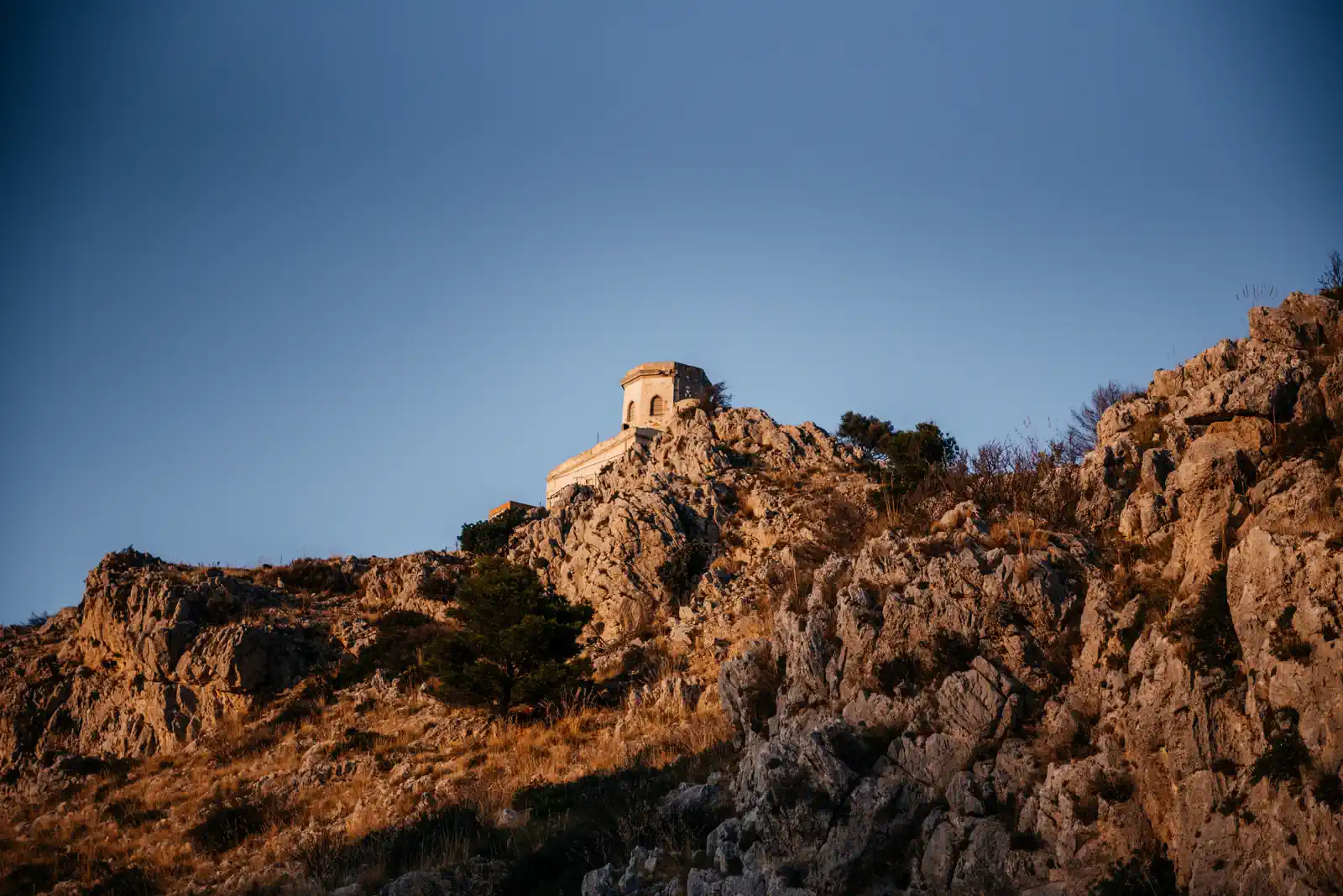
- ~527 mSummit altitude
- 12 kmFrom central Palermo
- ~90 minHike one way
- Moderate~325 m of climbing
- FreeHill trail · no ticket
Is the trail open right now?
As of , the official Monte Capo Gallo trail has been flagged closed following rockfalls from Pizzo Sella in February 2026. Closures here recur after heavy rain and summer fires, and signage is sparse, so always confirm the current status before setting out.
Verify locally with the Riserva Naturale Orientata Capo Gallo or check recent AllTrails reports. If the hill trail is closed, the sea-level coastal route to the Faro di Capo Gallo lighthouse is a good fallback.
Why the Semaforo dell'Eremita Is Palermo's Most Unusual Half-Day in 2026
Twelve kilometres from Palermo's Teatro Massimo, on the bald white limestone of Monte Gallo, a 19th-century Bourbon naval semaphore stands where it has for nearly two centuries. Its outer walls are sealed with sheet metal and covered in mosaics of bottle-bottoms, sea-glass and broken tile. Its resident is a former bricklayer named Nino, who has lived here alone since 1997 and asks to be called Isravele — elevarsi, "to rise up", spelled backwards.
There is no road to his door, no restaurant and no electricity — only a steep, sun-blasted track he renamed the Via Santa, climbing past the abandoned concrete skeletons of one of Italy's most notorious mafia subdivisions. The reward bundles four experiences into a single half-day: Bourbon naval history, a living outsider-art monument, a 360° panorama from San Vito Lo Capo to Cefalù (with Etna on the clearest days), and a moral landscape you feel in your legs.
Why it stands out
- A Bourbon naval semaphore — not a lighthouse — at roughly 527 m
- A living hermit, Isravele, who has decorated the ruin since 1997
- Hand-made Art Brut mosaics covering every wall (covered in Raw Vision, 2013)
- A 360° panorama over Mondello, Monte Pellegrino and the Tyrrhenian Sea
- The subject of the 2022 documentary Lassù by Bartolomeo Pampaloni
Know before you go
- The trail closes after rockfalls and fires — check the status first
- About 90 minutes uphill, ~325 m gain, fully exposed; carry 2 L of water
- No restaurant, bar, drinkable water or toilets at the top
- The hermit may welcome you in or refuse entry — both are normal
- Ticks live on the descent; wear long trousers and check yourself after
Other Experiences You Might Enjoy Near Capo Gallo
The hike to the semaphore is free and self-guided, but the coast around it rewards a little planning. If you're basing yourself in Mondello or central Palermo, these are the tours that pair naturally with a day on Monte Gallo: the guided aperitivo hike to meet the hermit Isravele, boat trips and snorkelling in the Capo Gallo marine reserve, a Mondello beach day, the trek or cable car up Monte Pellegrino to the Santuario di Santa Rosalia, a Palermo street-food walking tour through Ballarò and the Vucciria, and day trips out to Monreale, Cefalù and San Vito Lo Capo.
Isravele: the Man Who Has Not Slept in His Own House Since 1997
A Palermo bricklayer turned self-styled prophet, a vision in 1985, and a ruin reborn as the "Faro di Dio".
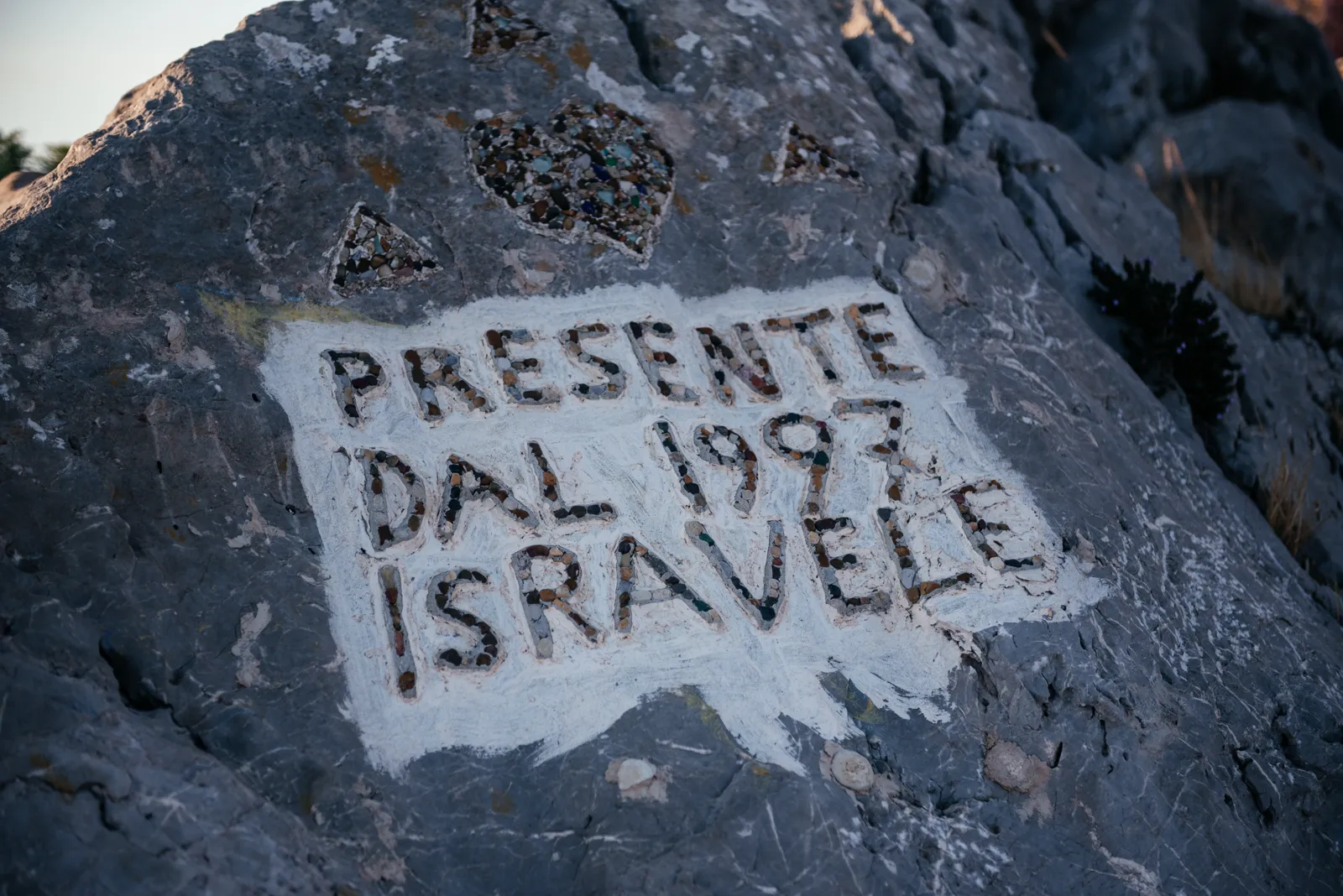
The hermit was born Nino in 1950, a married mason from Palermo. In 1985, by his own account, he had a vision in which God held two infants — Jesus and himself — and told him he was to be a prophet to "save souls". For more than a decade he tried to combine that calling with ordinary life. In 1997 he left his wife and children, lived briefly in a sea cave at Capo Gallo, then squatted the abandoned semaphore and began covering it in mosaics.
He took the name Isravele — elevarsi, "to rise up", read backwards — christened the building the Faro di Dio ("God's Lighthouse") and renamed the trail the Via Santa. He lives without electricity, a battery radio tuned permanently to Radio Maria, collecting rainwater and heating it with wood. His mosaics — sea-glass, shells, ceramic shards, bottle-bottoms — repeat Stars of David, angels, hearts and apocalyptic texts. Above a clock inside, one inscription reads ALLELUIAMEN.
He insists he is not a hermit in the classical sense: he did not retreat to seek God, he says, but to bring others closer to Him. As of 2026 he has lived here more than 28 years.
Good to know: Isravele may refuse to let you inside the building. This is normal and should be respected — you then see only the exterior mosaics, which are reason enough to climb. See hermit etiquette before you knock.
The Bourbon Semaphore: a Signal Station, Not a Lighthouse
It transmitted orders to passing ships and controlled traffic into the port of Palermo — and it is a separate building from the Faro di Capo Gallo.
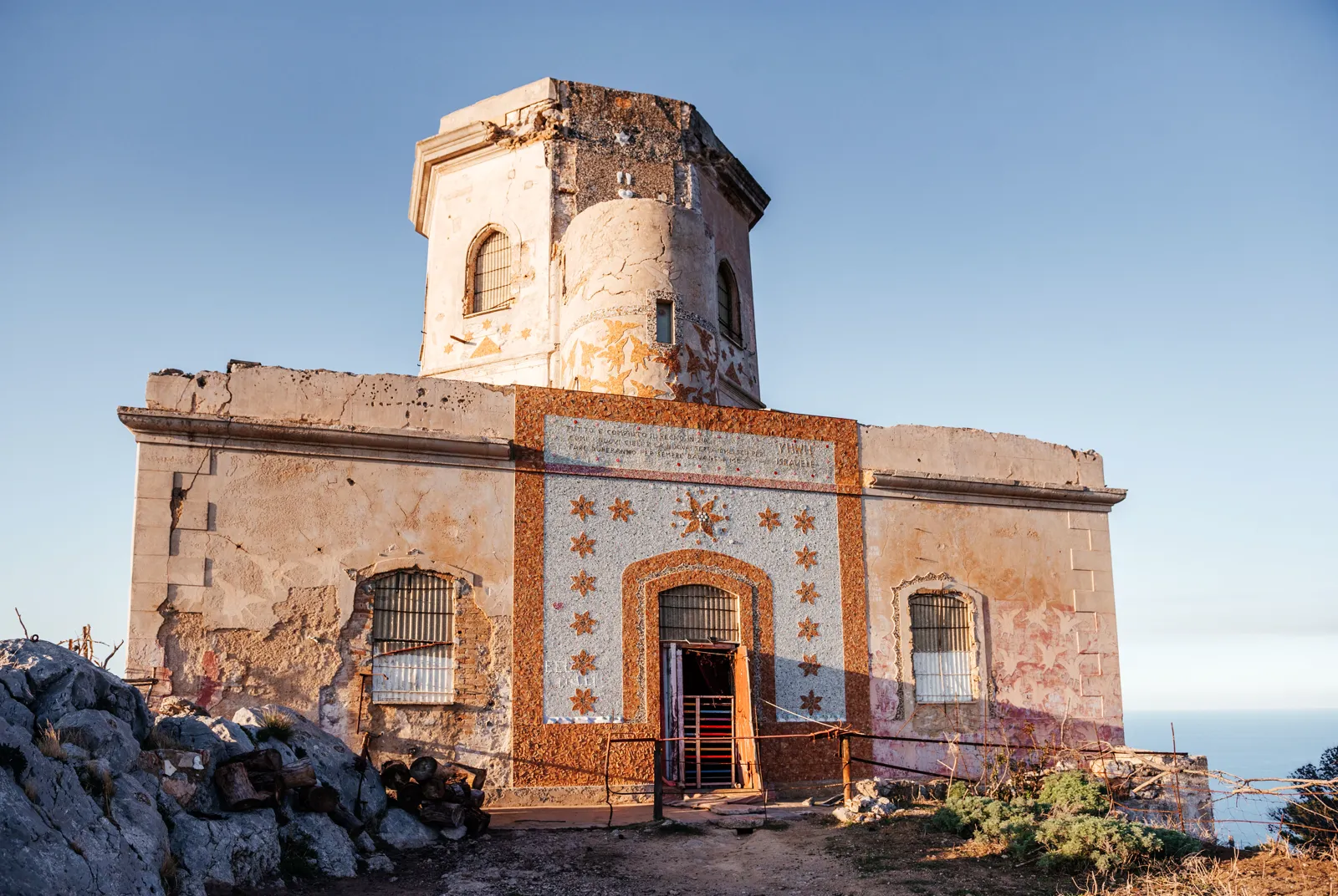
A semaphore is not a lighthouse. As Sicilian-history sources stress, unlike a lighthouse — a fixed point of reference for navigation — the semaphore carried equipment to transmit orders to passing vessels, regulating traffic toward the port of Palermo. It was part of the Bourbon optical-telegraph and coastal-watch network of the Royal Navy of the Kingdom of the Two Sicilies, which adopted the Depillon optical telegraph from 1812.
A signalling post on Monte Gallo appears in the 1818 list of Sicilian semaphore stations and is retained in the 1838 reform list (telegrafiduesicilie.it), so a semaphore on this site predates 1818; the masonry building you see is described only as "19th century". It is built on a square plan with rooms in sequence, a central staircase to an octagonal lookout tower, and external rock-cut cisterns. The network fell out of use with electric telegraphy; during World War II the post was briefly a German lookout, and a local legend says Isravele's mosaics deliberately cover a Nazi cross.
Good to know: The Semaforo dell'Eremita (hill, hermit, semaphore) and the Faro di Capo Gallo (the actual 1854 working lighthouse at sea level, built under Ferdinando II) are two completely different buildings, reached by two different routes. Most articles confuse them.
The Faro di Dio: One of Europe's Striking Living Outsider-Art Sites
Mosaics of sea-glass and broken tile, stencilled angels, an offertorio room — and a feature-length film about the man who made them.
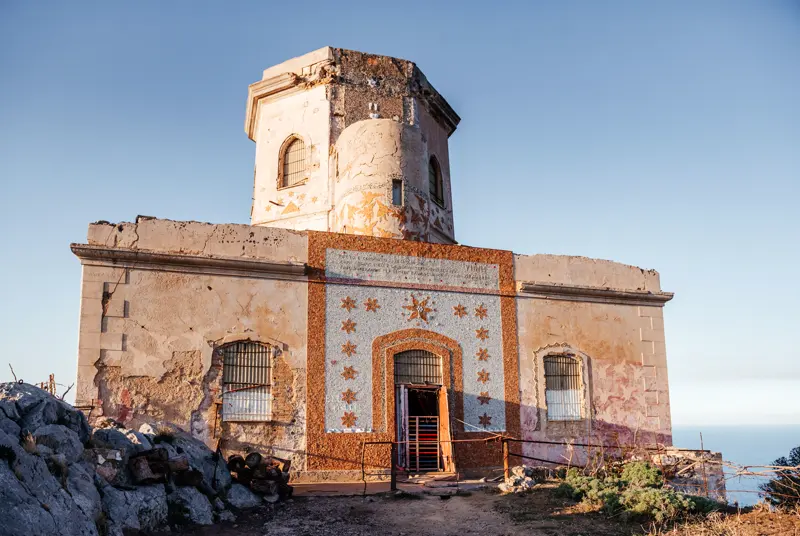
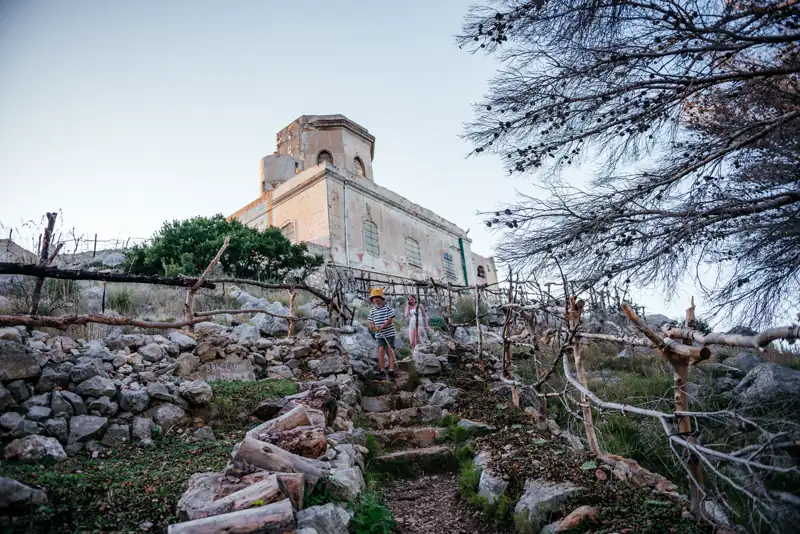
What visitors actually see is an entire building turned into a work of art. Every exterior and interior wall is covered with mosaics of sea-glass, broken tiles, bottle-bottoms and terracotta; doors carry stencilled angels with swords; walls bear Stars of David, hearts and painted apocalyptic texts. There is an offertorio room where visitors leave food offerings, a vegetable garden, a wood-fired oven, and red-painted stones and terracotta sheep lining the Via Santa like a personal Via Crucis.
Art historians classify the work as Art Brut / outsider art. It was covered by Eva di Stefano in Raw Vision no. 78 (Spring 2013) and has its own entries in Outsider Environments Europe and Outsider Art Now. In 2022 the Tuscan director Bartolomeo Pampaloni released Lassù ("Up There", 80 min) after living next to Isravele in a tent for about 18 months; it won the Premio Montagne d'Italia for best Italian film at the XXV Cervino CineMountain festival and is distributed internationally by Berta Film / Antidote Sales.
How to watch Lassù
Seek it out at art-house festivals and through its international distributor, Berta Film / Antidote Sales. It is the single best primer on Isravele's world before you climb — and a graceful way to understand the place if the trail is closed when you visit.
Good to know: The mosaics, the building exterior and the panorama are all fair to photograph. Do not photograph Isravele himself without his explicit permission, and never share images of his face without consent. See photography ethics.
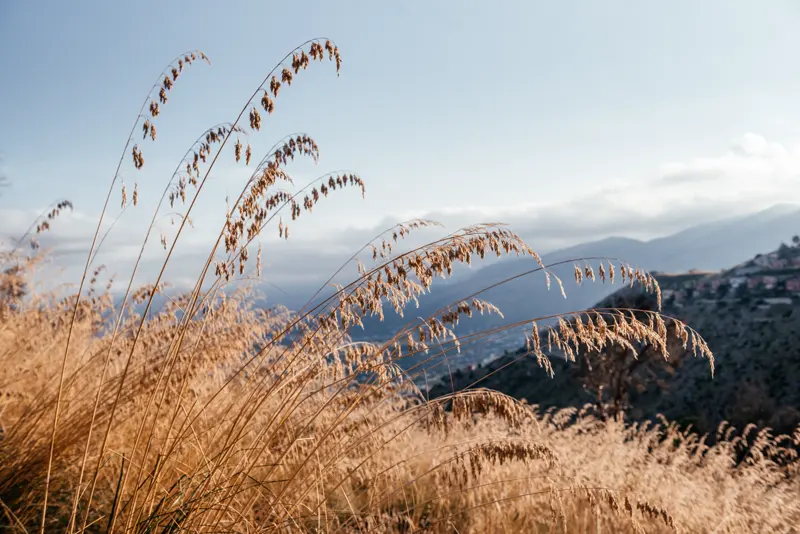
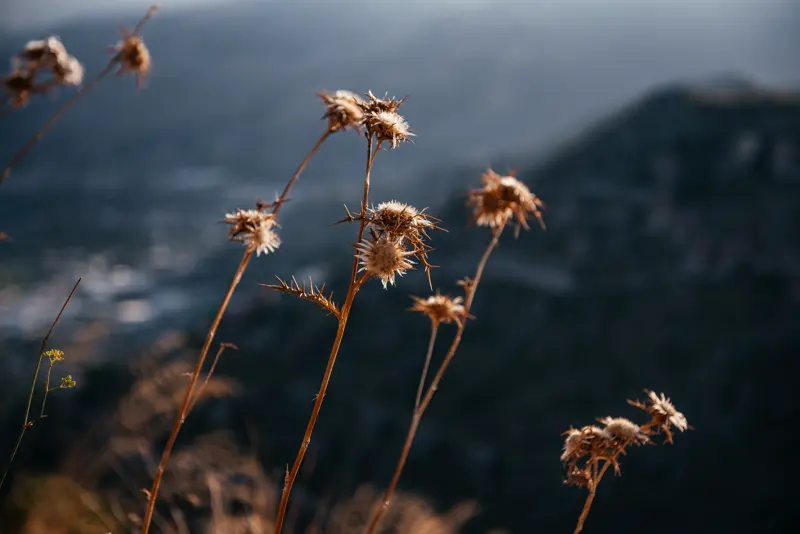
The Semaforo dell'Eremita in Photographs
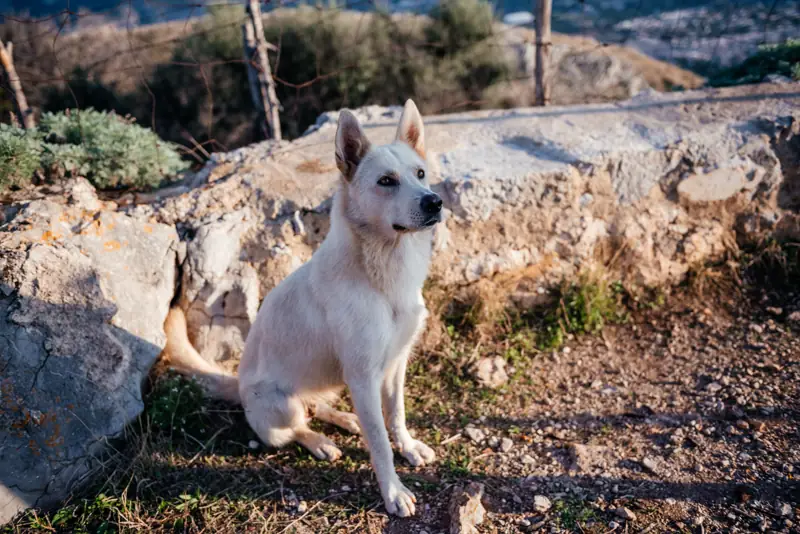
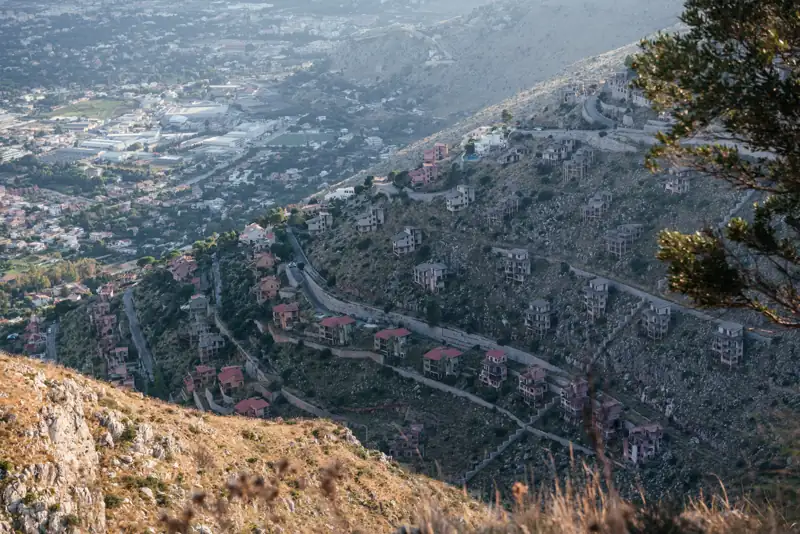
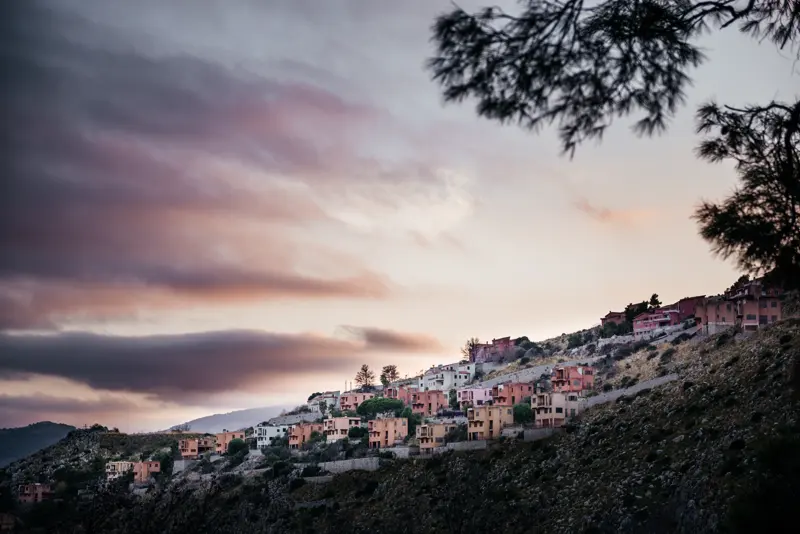
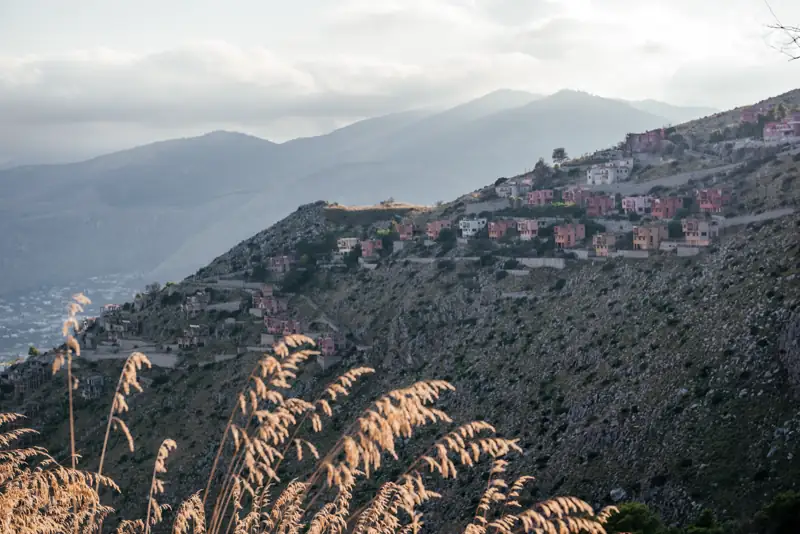
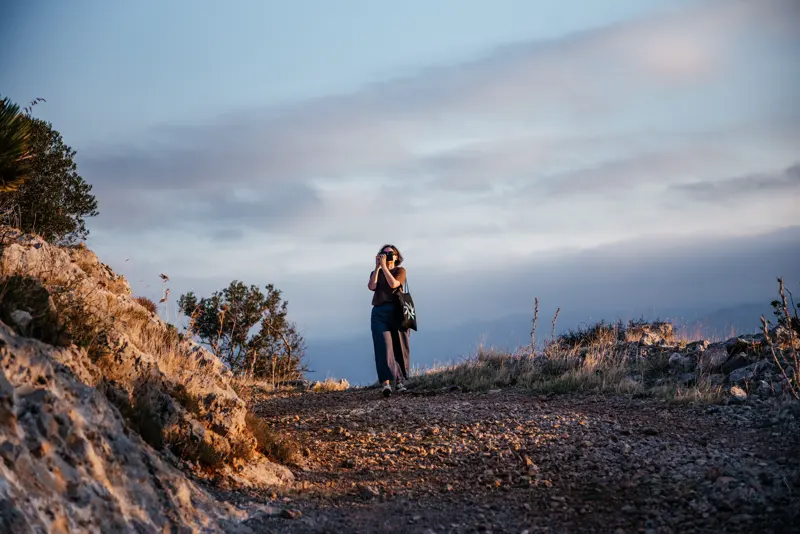
From the mosaic facade to the Tyrrhenian panorama and the Pizzo Sella villas below — scroll or drag to browse.
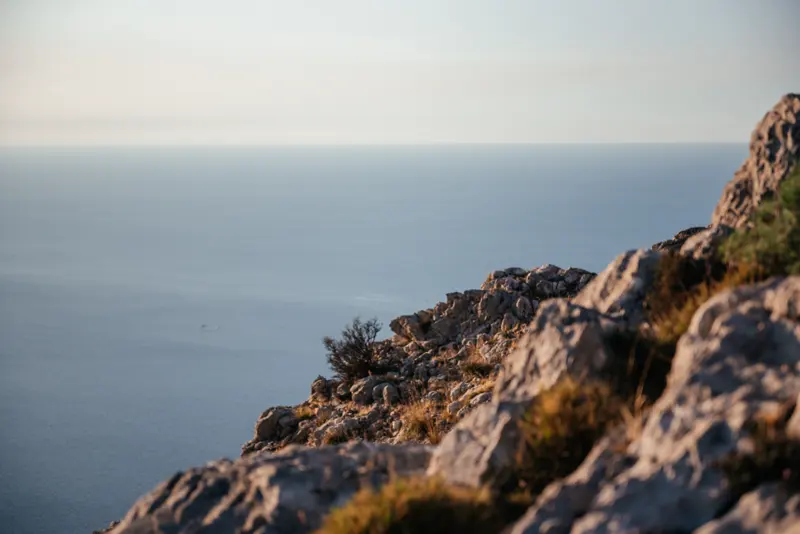
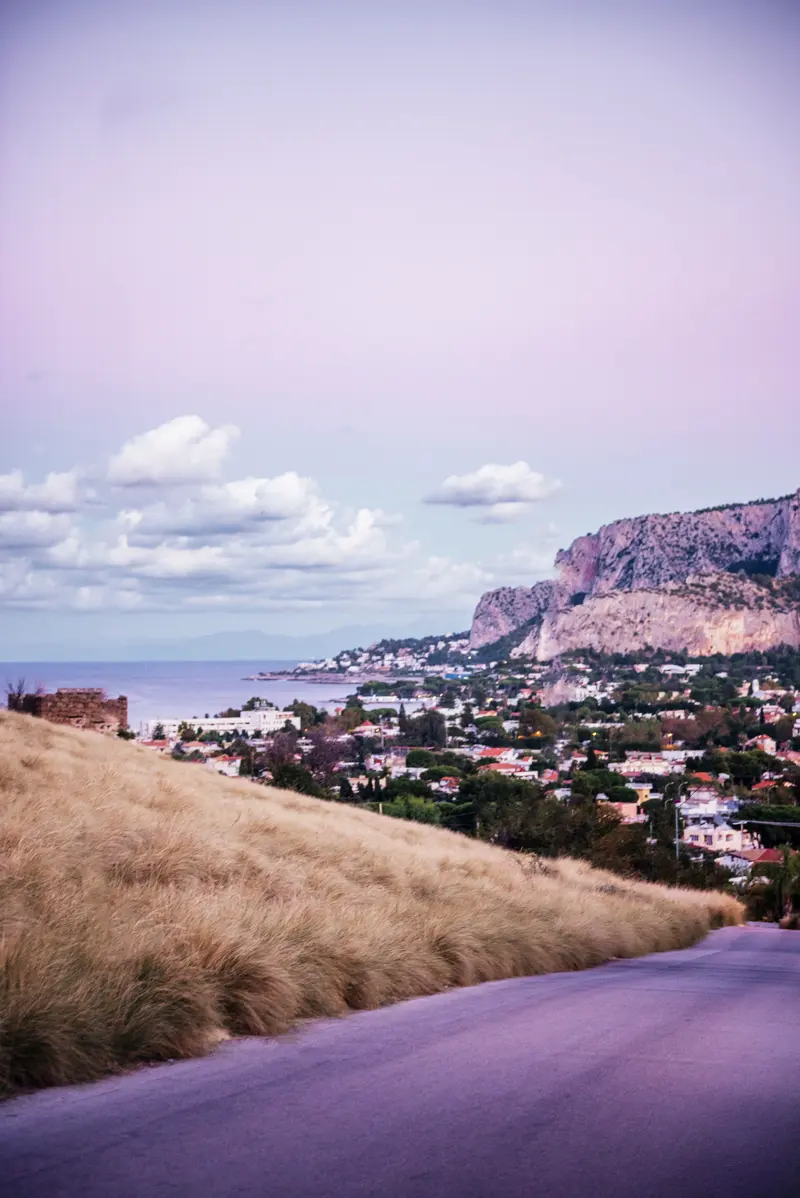
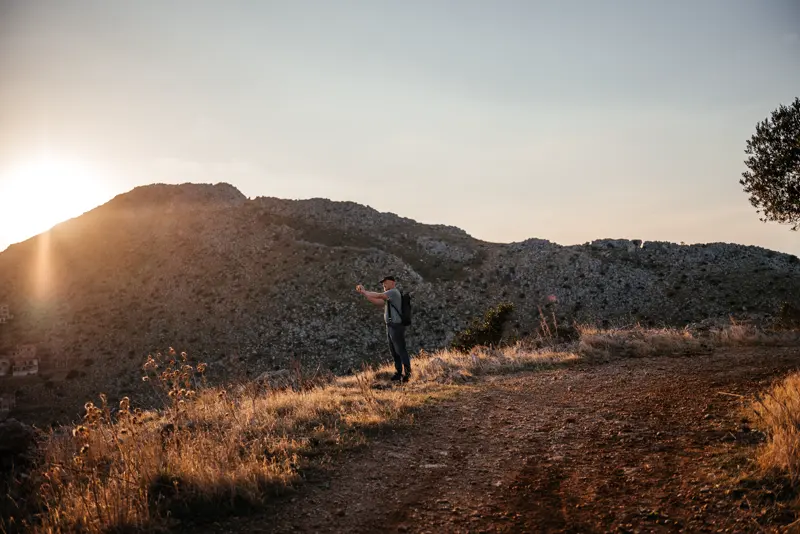
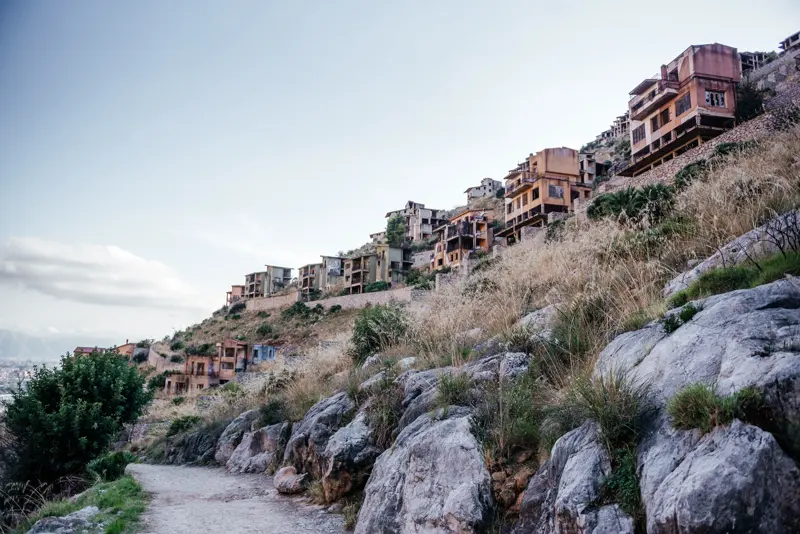
Pizzo Sella: the Hill of Dishonour the Climb Runs Alongside
Often missed in other guides — essential context for the concrete skeletons you pass on the way up.
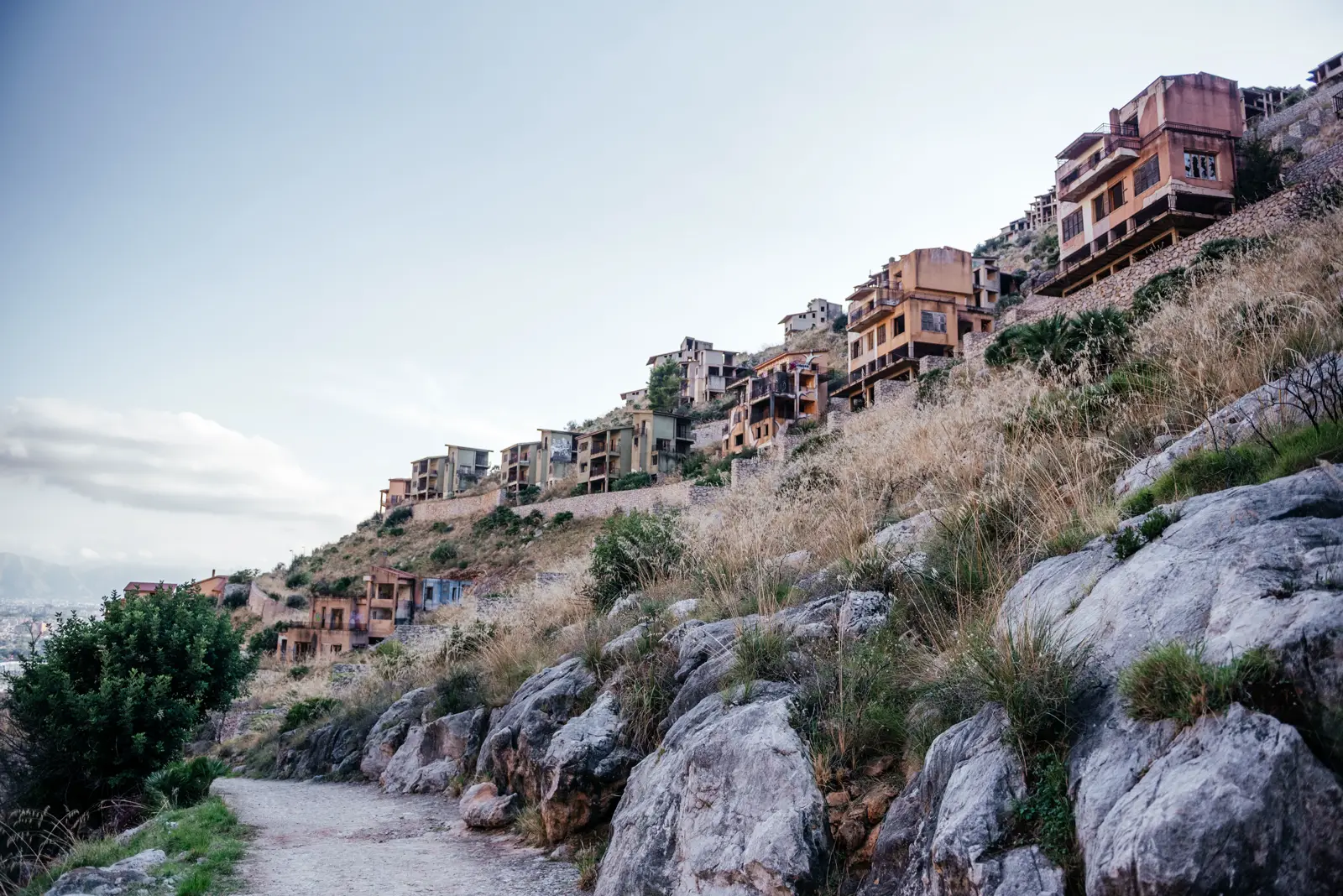
The first part of the climb runs alongside Pizzo Sella, "the hill of dishonour" — the notorious 1978 illegal subdivision of 170 villas built on a Cosa Nostra land-grab. The construction company Sicilcalce SpA was registered to Rosa Greco, sister of the mafia boss Michele Greco, with the work led by her husband, the contractor Andrea Notaro. The villas were never completed; their concrete skeletons still scar the hillside, some now painted by the Pizzo Sella Art Village.
The contrast is the moral heart of the whole experience: the mafia's most brazen land-grab below, one man's solitary, hand-made sanctuary above. Director Pampaloni said this contrast was what made him "see his film". Many Italian visitors describe the climb as cathartic for exactly that reason.
How to Get to the Semaforo dell'Eremita: Car, Bus, Scooter, Bike
From the green gate at the top of Via del Semaforo, Partanna-Mondello — four ways up, and one toll to avoid by mistake.
Trailhead: the intersection of Via Tolomea, Via Grotte di Partanna and Via del Semaforo, Partanna-Mondello quarter, 90151 Palermo. The green gate at the end of Via del Semaforo (approx. 38°12′46″N, 13°18′25″E) marks the official start of the reserve trail. From central Palermo it is about 12 km, a 20–30 minute drive off-peak.
Park low, walk up
SS113 to Mondello, then Via del Semaforo. The upper stretch is rough and very narrow with room for only a couple of cars — park lower on Via Tolomea and walk the rest.
From Politeama
Line 806 from Piazza Sturzo / Politeama to Mondello runs about every 10 minutes in summer; fare €1.20 (or €1 via app in summer). Then ~25 minutes uphill on foot to the trailhead.
The easy option
Recommended — quicker than the bus and far easier to park than a car on the narrow upper road. An e-bike works too.
Asphalt then push
The lower asphalt sections are rideable. Beyond the green gate the steep cobbles are push-only for most riders; the upper trail is really for walking.
Critical distinction: the hill route (Via del Semaforo → the hermit's semaphore) is free, with no toll. The coastal route (Mondello beach → Faro di Capo Gallo lighthouse) charges €5 per car / €1 per pedestrian and leads to a completely different building. Don't pay the seaside toll expecting the hermit.
The Hike to the Semaforo: ~90 Minutes Up, ~325 m of Climbing
From the Via del Semaforo green gate, past Pizzo Sella and Piano dello Stinco, to the panorama at ~527 m — stage by stage.
| Metric | Value |
|---|---|
| Distance (round trip) | 5.5–6.3 km out-and-back |
| Elevation gain | ~325–440 m |
| Time up | 60–90 min (3–4 h round trip with stops) |
| Difficulty | Moderate — non-technical, but relentless on hot days |
| Trail type | Out-and-back; loop extensions possible |
-
Start at the Via del Semaforo green gate
Begin at the green forestry gate in Partanna-Mondello (~200 m), where Via del Semaforo meets the reserve. Signage is sparse, so load an offline GPX track first (Komoot, Wikiloc or AllTrails). The first stretch is asphalt, then cobbles.
-
Climb past the Pizzo Sella villas
The first ~1.5 km runs uphill alongside the abandoned villas of Pizzo Sella, the 1978 mafia subdivision. Atmospheric and slightly haunting; some are now street-art canvases. See the Pizzo Sella story for context.
-
Into the macchia, past Isravele's first markers
Beyond the gate the path enters pine, holm-oak and lentisk, then opens onto Mediterranean macchia with dwarf-palm stands. Here you spot the hermit's first signs — red-painted stones, terracotta sheep and Stars of David edging the Via Santa.
-
Piano dello Stinco & the Torre Amari detour
Cross Piano dello Stinco, an upland plateau with a sweeping view over Mondello, Monte Pellegrino and Capo Zafferano. An optional 5-minute detour east reaches Torre Amari / Dammuso di Gallo, a 14th–15th-century vaulted cistern at ~475 m.
-
The final switchback to the Semaforo (~527 m)
A last 10-minute cobbled switchback reaches the semaphore at roughly 527 m. The panorama opens north over the Tyrrhenian to Isola delle Femmine and Punta Raisi, west to San Vito Lo Capo, east toward Cefalù — and, on the clearest days, south-east as far as Etna's plume.
Family suitability: good for active children aged about 8 and up. Not suitable for pushchairs, wheelchair users or very young children — it is a sustained 300 m-plus climb on rough, uneven cobbles.
Best Time to Visit: Season by Season, and the Best Hour of Day
The trail is south-facing and fully exposed — when you go matters as much as whether you go.
| Season | Verdict | What to expect |
|---|---|---|
| Apr – early Jun | Ideal | Wildflowers (including the rare Anthemis ismelia), moderate temperatures, good visibility, low ticks. |
| Late Sep – Oct | Ideal | Cooler air, golden light, fewer visitors. The sweet spot alongside spring. |
| Jul – Aug | Sunrise only | Brutal heat on the white limestone and high fire risk. Start before 8:00 or skip it. |
| Nov – Mar | Clear but risky | The clearest long-distance views, but slippery cobbles after rain and the highest rockfall risk. |
Best hour: mornings in summer (the route is exposed all day); late afternoon and golden hour in spring and autumn for the views over Monte Pellegrino and the Bay of Mondello. Bring a head-torch if you'll descend after dark.
What to Bring: Water, Shoes, Long Trousers, a Food Offering
There is no water, food, shade or toilet at the top — so what you carry up is all you have.
Don't go without
- Trekking shoes with ankle support (trainers only if dry)
- 1.5–2 L water per person — none on route
- Sun hat, sunglasses, SPF 50 (~70% of the route is exposed)
- Long trousers for tick protection on the descent
Bring if you can
- Offline GPX track on your phone (signage is sparse)
- A small food offering for the offertorio: pasta, biscuits, rice, bread
- Light wind or rain shell (the summit is windy outside high summer)
- Head-torch if returning at dusk or later
Comfort extras
- Trekking poles for the loose cobble descent
- A wide-angle camera lens for the panorama
- A picnic — many bring a panino with panelle from Mondello
Good to know: there is no water, no food, no toilet and no shade at the summit other than the building itself. Carry everything you need, and pack out all your rubbish.
Hermit Etiquette: How to Visit Isravele Respectfully
This is the most common source of bad visitor experiences — and the easiest to avoid.
Please do
- Bring a small food offering — pasta, biscuits, bread, a blanket — and leave it in the offertorio room, not at the door
- Come quietly: the Via Santa is not a conventional tourist attraction
- Knock gently and wait — he may open, say nothing, or say no
- If he lets you in, let him speak at his own pace; he takes his mission seriously
- If you wish, leave a donation toward building materials — welcomed, never required
Please don't
- Push if he declines — this is his home, and refusal is normal
- Film or photograph him without asking explicitly first
- Arrive in a large, noisy group
- Approach the building before leaving your offering in the offertorio
- Be alarmed by the two guard dogs that sometimes live with him — give them space
Good to know: whether Isravele welcomes you in or turns you away is entirely unpredictable, and both happen often. Treat being let inside as a gift, not an entitlement.
Is It Worth It? Who Should Climb, and Who Should Skip It
One of the most unusual, contemplative half-days near Palermo — but genuinely not for everyone.
- Love history with a twist — a Bourbon naval empire reborn as one man's sanctuary
- Are drawn to outsider art or Art Brut
- Want a genuine half-day off the tourist track near Palermo
- Are a photographer or filmmaker chasing light and texture
- Are a couple after an alternative to Mondello's crowds — sunset here is a local classic
- Only have two hours in Palermo — this deserves a half-day
- Can't manage 300 m of sustained climbing on rough cobbles
- Are visiting in peak-summer heat without an early start
- Expect a restaurant, a bar or guaranteed access to the interior
- Have no flexibility on weather between November and March
Verdict: one of the most unusual, contemplative half-days available near Palermo. Not for everyone — and better for it.
Alternatives Near Palermo: Pellegrino, Capo Gallo Lighthouse, Utveggio
If the trail is closed, the heat is brutal, or the climb is too much — here's where to go instead.
| Option | Difficulty | Time | What's there | Best for |
|---|---|---|---|---|
| Semaforo dell'Eremita | Moderate | 3–4 h | Hermit, mosaics, semaphore, 360° panorama | Culture-seekers, hikers, photographers |
| Monte Pellegrino + Santa Rosalia | Easy (bus) | 2–3 h | Sanctuary, panorama, pilgrim atmosphere | Families, first-timers |
| Faro di Capo Gallo (coastal) | Easy | 2–3 h | Working 1854 lighthouse, sea caves, snorkelling coves | Non-hikers, swimmers |
| Castello Utveggio | Very easy (car) | ~1 h | Art-deco castle, Palermo panorama | Limited mobility, time-poor |
Short version: for the strangest, richest half-day, climb the Semaforo; for an easy view with bus access, choose Monte Pellegrino; for the sea, take the coastal Capo Gallo lighthouse route.
Make It a Sicilian Trip: Tours & Day Trips Across the Island
The Semaforo is one strange half-day in a region full of them. If you have longer, Sicily opens up fast: the Greek temples of the Valley of the Temples at Agrigento, the Baroque hill towns of the Val di Noto, an Etna summit hike or wine tasting on its slopes, the mosaics of the Villa Romana del Casale, the seaside theatre at Taormina, the salt pans and windmills of Trapani and Marsala, and boat trips to the Aeolian Islands, Favignana and the Egadi. Browse experiences from across Sicily below.
Combine It: a Full-Day Itinerary From Trailhead to Aperitivo
Climb in the cool of the morning, swim at Mondello, end with a spritz on the promenade.
- 7:30 – 8:00
Leave Palermo
Depart by scooter or car for Partanna-Mondello while it's still cool.
- 8:30
Start the hike
Set off from the Via Tolomea / Via del Semaforo trailhead with full water bottles and your offering packed.
- 10:00 – 10:30
Reach the Semaforo
Take in the mosaics and the panorama, and leave your offering in the offertorio before approaching the door.
- 11:30 – 12:30
Descend to Mondello
Walk back down (tick check at the bottom) and reward yourself with a panino con panelle e crocchè from the kiosks, under €5.
- 14:00 – 17:00
Swim at Mondello
Cool off at the beach or the historic Antico Stabilimento Balneare.
- 18:00
Aperitivo & the markets
A spritz on the Mondello promenade, then — optionally — an evening in the Ballarò or Vucciria markets back in Palermo.
Costs at a Glance, and the Guided Options That Exist
What you'll actually spend — and the small operators who run guided hikes if you'd rather not navigate alone.
| Item | Cost |
|---|---|
| Self-guided hike (hill route) | €0 |
| Reserve entrance (hill route) | €0 |
| Parking | Free, limited street parking |
| AMAT bus 806 | €1.20 (or €1 via app in summer) |
| Coastal Capo Gallo route (car) | €5 per car |
| Coastal Capo Gallo route (on foot) | €1 per person |
| Aperitivo guided hike (Sicilian Vibes) | From ~€32–35 per adult |
Guided options, if you want them
This is an independent guide — we don't sell or book anything. If you'd rather walk with someone who knows the story and the route, a few small Sicilian operators run guided hikes you can arrange directly:
- Sicilian Vibes — an "Aperitivo on Monte Gallo with a Hermit" guided hike (2–3 hours, wine or Aperol Spritz plus local snacks, private 1–12 guests, ages 14–75), from about €32–35 per adult, meeting at the Via Grotte di Partanna green gate. Listed on Tripadvisor, Viator and byFood.
- Naturando Sicilia — seasonal evening "escursioni notturne sotto le stelle" to the semaphore, nature-walk format (contact via WhatsApp +39 329 985 4681).
- CAI Palermo — longer full-loop hikes (4–6 hours) including the Bauso Rosso panoramic point, for serious walkers.
No booking is needed for the self-guided hike — download a GPX track and go. Prices and availability are set by the operators and change; confirm directly with them.
The Reserve: Riserva Naturale Orientata Capo Gallo
The semaphore sits inside a protected reserve with rare endemic plants and a marine area below.
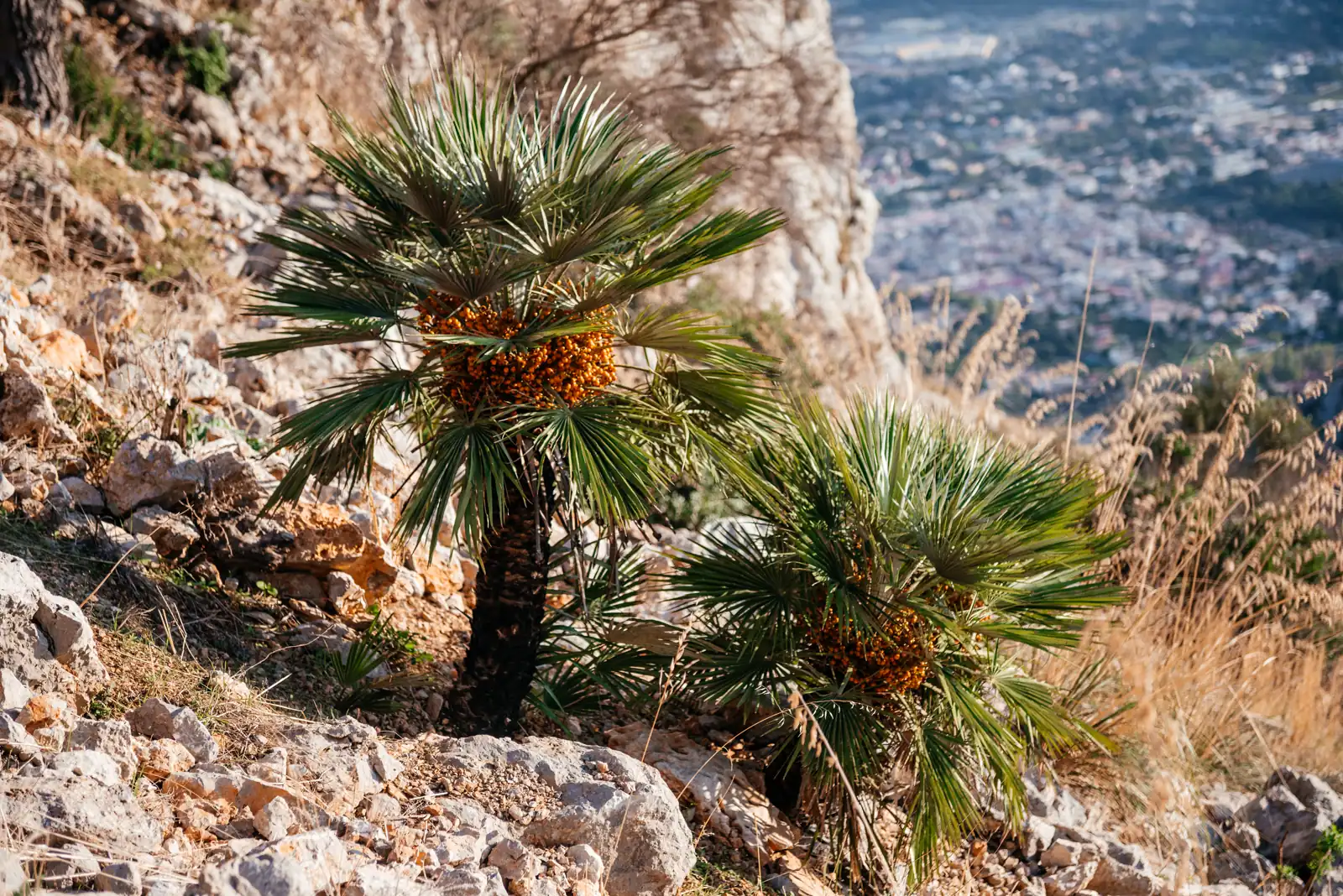
The Riserva Naturale Orientata Capo Gallo covers 586 hectares, established in 2001 (D.A. n. 438, 21 June 2001) and managed by the Azienda Regionale Foreste Demaniali. It has been on FAI's "I Luoghi del Cuore" list since 2003 and adjoins the Capo Gallo–Isola delle Femmine Marine Protected Area (2002).
Notable species you may meet on the climb:
- Anthemis ismelia — the Monte Gallo chamomile, a rare endemic found almost nowhere else
- Ophrys panormitana — Palermo's own wild orchid
- Chamaerops humilis — dwarf palm, the only native European palm, abundant here
- Eleonora's falcon — a seasonal nester on the cliffs
- The vermetid "trottoir" reef along the coast — ecologically comparable to a coral barrier
How to Help Isravele
He lives entirely on what hikers carry up and what he carries on his own back.
If you'd like to contribute something useful, the most meaningful gesture is simple and physical: carry something up, and leave it the right way.
What to bring
- Dry pasta, rice, lentils, biscuits, bread, tinned food
- Building materials — tiles, mosaic pieces, cement
- Blankets and warm clothing
How to give
- Leave offerings in the offertorio room — not at his door
- Don't deal with third parties claiming to act on his behalf
- Respect his privacy: don't share his details or photograph him without consent
He has chosen this life deliberately. The best thing any visitor can do is arrive respectfully and leave something he can actually use.
Semaforo dell'Eremita: Frequently Asked Questions
The questions people actually ask about the hermit, the hike and the history.
What is the Semaforo Borbonico dell'Eremita?
It is a 19th-century Bourbon-era naval semaphore station on top of Monte Gallo, at roughly 527 m, about 12 km north-west of central Palermo. Part of the Kingdom of the Two Sicilies optical-telegraph network, it was abandoned for about 50 years until 1997, when a Palermo ex-bricklayer known as Isravele moved in and covered it in hand-made mosaics.
Is it a lighthouse or a semaphore?
It is a semaphore, not a lighthouse. A semaphore transmitted visual orders to passing ships and regulated traffic into the port of Palermo; it never carried a navigation light. The actual working lighthouse, the Faro di Capo Gallo (1854), is a separate building at sea level on the cape, reached by a different coastal route.
Who is Isravele, the hermit of Capo Gallo?
Isravele was born Nino in 1950, a married mason from Palermo. After a religious vision in 1985, he left his family in 1997 and moved to Monte Gallo. He renamed himself Isravele — elevarsi, to rise up, spelled backwards — and has decorated the abandoned semaphore with mosaics ever since. He is classed by art historians as a leading living example of Art Brut / outsider art.
Is the hermit still living there?
Yes. As of 2026 Isravele has lived at the semaphore for more than 28 years, without electricity, with a radio tuned to Radio Maria, a vegetable garden and a wood-fired oven. He still walks down to Partanna-Mondello for supplies, carrying building materials back up on his back.
Is there a restaurant at the Semaforo dell'Eremita?
No. There is no restaurant, bar, kiosk or agriturismo at the semaphore, and no toilet or drinkable water at the summit. The nearest food and drink is at sea level in Mondello, about 3 km and 300 m of altitude away. Bring everything you need.
How long is the hike to the Semaforo dell'Eremita?
Allow 60–90 minutes one way and 3–4 hours round trip with stops. The standard route from Partanna-Mondello is roughly 5.5–6.3 km out-and-back with about 325–440 m of elevation gain, depending on where you park.
Is the trail open right now?
Check before you go — the trail closes periodically. It was closed in February 2026 after rockfalls from Pizzo Sella, and closures recur after heavy rain and fires. Verify the current status with the Riserva Naturale Orientata Capo Gallo (riservacapogallo.it) or recent AllTrails reports before setting out.
What should I bring on the hike?
Trekking shoes, 1.5–2 litres of water per person, a sun hat, sunglasses and SPF 50, and long trousers for tick protection on the descent. Strongly recommended: an offline GPX track, a small food offering for the offertorio, a light wind shell and a head-torch if returning at dusk.
Are there ticks on the trail?
Yes — ticks are repeatedly reported on the descent, especially in the dry grass east of the semaphore. Wear long trousers in spring and summer and check yourself afterwards, particularly behind the knees, at the hairline and the waistband. Almost no other English-language guide mentions this.
Is the hike suitable for children?
It suits active children aged about 8 and up. The path is non-technical but involves a sustained climb of more than 300 vertical metres on rough, uneven cobbles, with full sun exposure and no facilities. It is not suitable for pushchairs, very young children or anyone with mobility limitations.
What is the best season to visit?
April to early June and late September to October are ideal: warm but not hot, with good visibility. In July and August go at sunrise only — the white limestone is brutally hot and fire risk is high. November to March offers the clearest views but slippery cobbles and higher rockfall risk.
How much does it cost?
The hill route to the semaphore is free: no ticket, no reserve entrance fee, and free street parking. The AMAT bus 806 to Mondello costs about €1.20. Note the separate coastal route to the Faro di Capo Gallo lighthouse charges a €5-per-car / €1-per-pedestrian toll — that is a different destination.
Where do I park?
There is no formal car park. Park on the street near the start of Via del Semaforo or lower on Via Tolomea in Partanna-Mondello, then walk up — the upper stretch is rough, stony and very narrow, with room for only a couple of cars at the top. A scooter is easier to park than a car.
What is the aperitivo tour, and how do I book it?
It's the "Aperitivo on Monte Gallo with a Hermit" guided hike run by the small Palermo operator Sicilian Vibes — 2–3 hours, wine or Aperol Spritz plus local snacks, private groups of 1–12, from about €32–35 per adult. It's listed on Tripadvisor, Viator and byFood; book directly with the operator, ideally 24–48 hours ahead.
Will I meet the hermit?
Sometimes. Isravele refuses entry roughly as often as he allows it, and there is no predicting which you will get. Knock gently, leave a small food offering in the offertorio, and accept his answer without pushing — the building is his home. Do not film him without explicit permission.
What are the best alternatives near Palermo?
For an easier panorama, Monte Pellegrino and the Santuario di Santa Rosalia have bus access. For the sea, the coastal Faro di Capo Gallo route reaches the 1854 lighthouse, caves and snorkelling coves. For limited mobility, Castello Utveggio is reachable by car with only a short walk to the viewpoint.
Before You Share, and Where This Guide Comes From
Accessibility
The Semaforo dell'Eremita is not accessible for wheelchair users, pushchairs, or visitors with significant mobility limitations. The trail involves ~325–440 m of sustained climbing on rough, uneven cobble and rock, and no accessible route to the summit exists. The nearest accessible panorama near Palermo is Castello Utveggio on Monte Pellegrino, reachable by car with a short walk to the viewpoint.
Photography & social-media ethics
The mosaics, the building exterior and the panorama are all fair to photograph. Do not photograph Isravele without his explicit permission, and do not share images of his face without consent. The best respectful shots: exterior mosaic walls with the Tyrrhenian behind, the angel-stencil door, the Via Santa red stones with Mondello below, and the wide golden-hour panorama from the summit.
Sources & further reading
- Official: riservacapogallo.it — Riserva Naturale Orientata di Capo Gallo.
- History: telegrafiduesicilie.it — the Bourbon optical-semaphore network; Eva di Stefano, "Isravele", Raw Vision no. 78 (Spring 2013).
- Trail maps & GPX: AllTrails, Komoot and Wikiloc — search "Monte Capo Gallo Semaforo".
- The documentary: Lassù (2022, dir. Bartolomeo Pampaloni), distributed by Berta Film / Antidote Sales.
- Outsider art: Outsider Art Now and Outsider Environments Europe — entries on Isravele.
This is an independent, non-commercial visitor guide. It does not sell tickets, tours or accommodation, and is not affiliated with the reserve, the hermit, or any operator named here. Details such as trail status, prices and timetables change — always confirm with official and local sources before you travel.
Plan Your Visit to the Semaforo dell'Eremita
Go in spring or autumn, start in the morning, carry two litres of water and a small offering — and check the trail status before you set out.
- Check the trail status first
- ~90 min up · ~325 m gain
- Free on the hill route
- Bring water · no facilities at the top